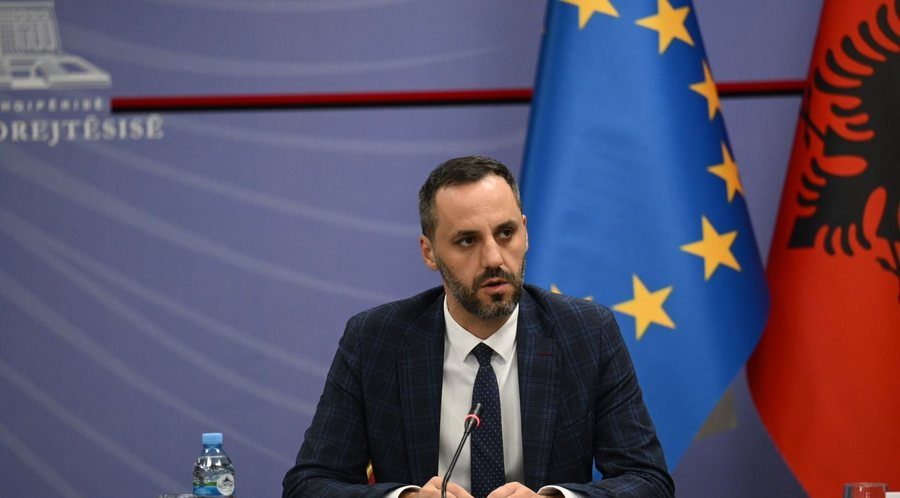


Conference of Rectors Meets to Review Higher Education Institutions’ Performance
The Conference of Rectors convened today, with the participation of rectors from both public and private universities, for an open discussion on the quality of higher education institutions in the country and on scientific research. The discussion underlined the need to move to a higher level of performance through stronger internationalization and clearer institutional profiling.
Prime Minister Rama, who attended the Conference together with the Minister of Education, Mirela Kumbaro, stressed, among other points, that the time has come to revise the Higher Education Law, to reflect both the changes brought by evolving circumstances and the practical lessons learned from its implementation within the existing legal framework.
***
Prime Minister Edi Rama:
Thank you very much, and greetings to everyone. We haven’t met this year yet, so let me wish you all a very successful year ahead, both in your family life and in your professional lives.
I won’t take too much of your time. I just want to touch on a few points that, from my perspective, are important for this discussion. At the same time, I want to genuinely acknowledge the cooperation we have built and the continuity of our communication through a path that has been as institutional as it has been open and informal. This has given us the opportunity to stay constantly in touch with one another, to listen to one another, and to understand more in real time.
It is time to revisit the Higher Education Law, because enough time has now passed to reflect in that law both the changes brought by the times, and what practical implementation has revealed in relation to the law’s framework.
Fortunately, we have a solid previous experience. As you know, the current law was drafted in cooperation with you, with your contribution, so I expect this will be the case again. I hope and believe that, both because of the experience we now have and because this time it is not about a complete overhaul as it was when the law was first written, but rather about corrections, it will be possible to do this within a reasonable timeframe. I also believe we will not have to wait for the next parliamentary session to prepare the groundwork for these amendments. The parliamentary procedure may take place at the end of this session, or at the beginning of the next, but what matters is that we organize ourselves with a joint working group to address all concerns and observations, and to draft the changes.
The second point I want to underline, which is also the core of my intervention here today (and I thank you for the invitation), is that we must not lose sight for even a moment of the fact that our shared, fundamental challenge is: on the one hand, the internationalization of the university, and on the other, the rationalization of resources and potential.
There has been an important change in the approach taken by the university. And when I say, “the university”, I mean higher education, not any specific institution. There has been a significant shift in the approach to funding, meaning that until yesterday everything was tied to the state budget. Today, the University of Tirana is at the forefront of a number of universities that have increased their financial capacity outside the state budget, effectively becoming able to build teams and develop projects or European partnerships, and to benefit from European funds, something that has certainly increased the income of the most active academics and has clearly created a new situation.
I would like that in our next meeting together we gather to discuss this process openly, and with your permission, I would like to invite all rectors, including those of private universities. I don’t call them nonpublic; I call all of them public; some are publicly funded, some privately funded, but they are public universities because they serve the public. So, let us all sit down and look this straight in the eye. The challenge is: let’s reorganize them into a far more competitive, far more credible system, and one far more prepared to face tomorrow with everything that will come with the process, with membership in the European Union.
University is the most important ally of the country’s institutions and of the country in a process like this. The facts show that the volume of funding, meaning the projects approved directly or through alliances here at the University of Tirana by the EU, increases every year. And there, no one gives you a bonus because you come from a country that is not yet integrated. There, everyone is assessed by the same standard, and under that standard, the academics of the University of Tirana, those who have entered this process, are evaluated on an equal footing with academics from Europe’s largest universities.
So, we need to value this capacity more and place it in conditions where it can be more effective across the territory.
The third issue I have is the matter of accreditation. To be honest, we have raised this repeatedly in joint meetings with the board. The ambition now is to launch the agency at another level, to integrate it with ENQA, and to increase institutional capacity to speed up the accreditation process.
I also want to pause for a moment on infrastructure. We have made quite a few changes, truth be told. I won’t list them here you know better than I do the investments we have made and that are either completed or ongoing. These are very significant investments, but we are still far from meeting the infrastructural conditions needed to face our challenges and needs.
You know that I believe strongly in buildings, and we have two campuses ahead of us. The large Tirana campus. Meanwhile, we have opened the process for the campus of Aleksandër Moisiu University. We have seen considerable interest from 40 international studios. There is major potential to create accommodation infrastructure too, student residences, considering that the train should be operational soon. It should become simple for students to be in Tirana, while having the possibility to stay in the Durrës campus. And for this reason, we will build a very good residential student complex to help solve a major problem students face because of the high rental prices in Tirana and in Durrës as well, of course, but especially in Tirana, and so on.
So, I believe we have a deeper understanding of needs and of the way we should address them.
Thank you very much.