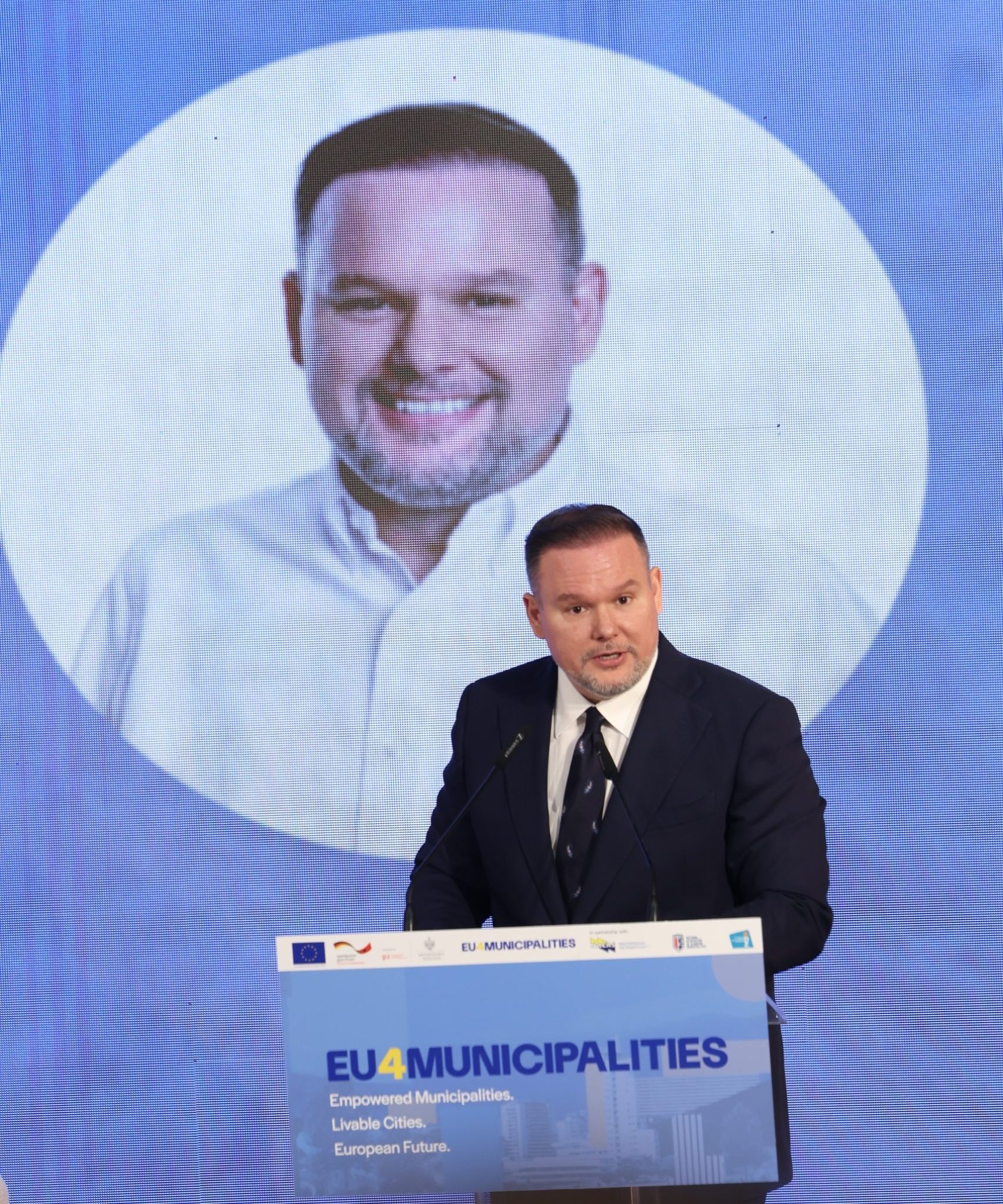


Minister Jaupaj Says Albania Launches the Largest Climate Project in the Western Balkans with $40 Million in Funding
Albania secured $40 million in funding for the “AlbaDapt” program, the largest climate change project currently implemented in the Western Balkans and supported by the Global Environment Facility (GEF).
Sofjan Jaupaj, the Environment Minister, made the announcement during a press conference held at the conclusion of the regional climate conference, “United for Climate.” The conference was organized in Tirana and attended by policymakers, climate experts, and representatives of European institutions and international environmental organizations. European Commissioner for the Environment Jessica Roswall also spoke at the event.
According to Jaupaj, the “AlbaDapt” project is unique in the region because no other European Union or Western Balkan country currently has a project financed by the Global Environment Facility. Jaupaj emphasized that the conference will be held annually in Albania, strengthening the country’s position in regional climate and environmental sustainability policies.
Jaupaj announced that Albania and North Macedonia secured guarantees for a new $50 million forestry project funded by a Green Climate Fund grant. He stated that the funds will be used to expand nurseries, reforest areas damaged by fires and erosion, and increase forest management capacity.
The minister also said that the Ministry of Environment introduced a draft law to create four regional forest agencies, in addition to the National Forest Agency. The new agencies aim to strengthen the ministry’s territorial presence and support municipalities in drafting forest management plans. Additionally, a State Forest Enterprise will be established based on models implemented in European countries with extensive forest resources, such as Austria.
In October 2025, registration of Albania’s entire forest fund was completed, covering approximately 1.2 million hectares of forests. Jaupaj stressed that this process lays the groundwork for more efficient forest management and expanding capacities related to restoring state nurseries and reforesting degraded areas.
The National Climate Change Plan 2026–2036 was also presented during the conference. The plan includes 66 priority measures to increase the country’s resilience to climate change effects, such as fires, floods, and droughts.
Jaupaj stated that the 10-year plan includes green, infrastructural, and soft measures for climate protection and that the total value of the required investments is estimated at around $9.8 billion. He added that there is currently a significant financial gap for the full implementation of these measures, which is why the document has been presented to the European Commission and international financial institutions to secure support for financing priority projects.
The minister also addressed the reform of the hydrometeorological system, emphasizing that a lack of investment and maintenance over recent decades has caused many meteorological and hydrological stations in the country to deteriorate. Jaupaj announced the launch of a collaboration with Swiss Meteo to modernize the system, increase the number of monitoring stations, and improve weather forecasting capabilities by 2027–2028, aligning them with European standards.
The minister also discussed air quality, describing it as one of the most challenging topics in Albania’s negotiations with the European Union. He announced that the Ministry of Environment opened a new air quality package for public consultation. The package includes a 10-year national strategy, an action plan, and a new draft law aligned with European directives.
The minister stated that Tirana, Durrës, Elbasan, and Korça remain among the cities with the worst air pollution due to traffic, industry, construction activity, and wood burning for heat in the winter. The minister announced that the government has allocated €5 million to expand air monitoring stations and has begun cooperating with the World Bank to establish a comprehensive monitoring system that aligns with European Environment Agency standards by 2028.