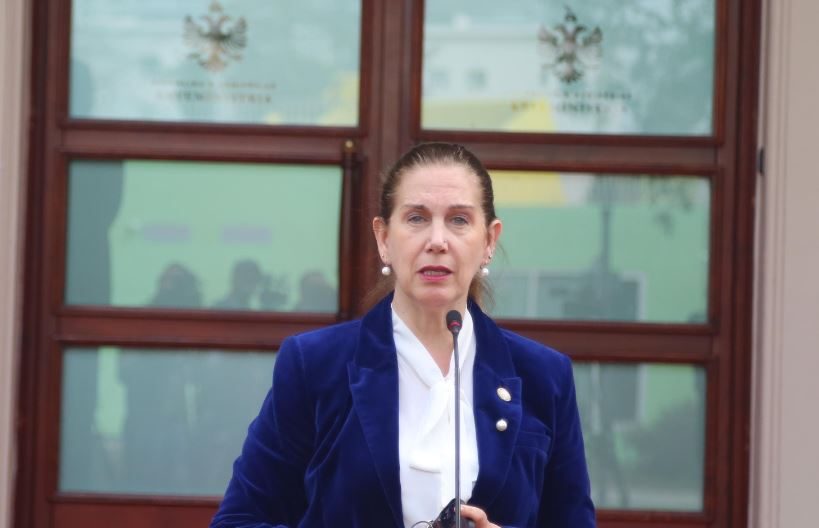


Albania welcomes for the first time in the Balkans the Annual IAIS Conference
Albania welcomes another prestigious international event, as the Annual IAIS Conference, the International Association of Insurance Supervisors, is being held for the first time in the Balkan region, placing Tirana at the center of the global spotlight of the insurance industry.
The event, which brings together the highest-level leaders of supervisory authorities from around the world, opened with the participation of Prime Minister Edi Rama, who emphasized the strategic importance of international cooperation in the face of today’s global challenges. In his opening remarks, the Prime Minister underlined that modern risks, from climate change to cyber threats- require comprehensive approaches and innovative solutions, praising the role of the insurance industry in strengthening economic and social resilience.
***
Good morning and let me tell you that I was a bit concerned when I entered the room, because it’s 9am and you were all here, which may mean that you didn’t have a long night last night, unlike what happened with a previous conference in the same room, where when I came, I found no one.
But maybe this is also a good sign, because when covering risks, you have to always sleep well. Thank you so much for being here, and I hope my outfit shows you how seriously I’ve taken this speech, and I was very delighted to see again in Tirana the master of this ceremony, Ali Aslan, my dear Turkish friend who happens to be German and with whom we joyfully share stages.
But in this case, I just have to speak alone, and I hope I’ll not be boring while trying to cover aspects of your daily struggle in a world that is more and more at risk, and in a time when we find ourselves surrounded by more risks than boundaries. Climate change, cyber threats and global market fluctuations are challenges that impact all of us and demand from us innovative and inclusive solutions.
The trouble is that the window for meeting global climate targets is closing very, very fast, and the consequences of inaction are already reshaping our economies and imposing very heavy prices on our daily lives.
In this defining moment, it goes without saying that the insurance industry is facing a tremendous challenge, and it is also facing very difficult choices in an effort to turn risk into resilience and shared security and more. Today’s risks are deeply interconnected. The threats to our climate resonate with financial uncertainties, while cyber intrusions intertwine with our economic stability and societal harmony. The very connections that foster growth can also heighten our vulnerabilities.
So, to secure a sustainable future, we must embrace a holistic approach to resilience that considers the myriads of challenges faced by families, businesses and nations alike. For smaller economies, the consequences of these global risks are amplified. While we confront the same threats as larger nations, we often lack the financial resilience, institutional strength and insurance coverage necessary to endure them. Recent years have revealed how quickly crises can disrupt our economies, impact our jobs, challenge our public services and stress our communities. Yet amidst these trials, there lies a powerful lesson: we may not foresee every calamity, but we can fortify ourselves to endure and to bounce back.
Building this resilience calls for a different mindset, a proactive one. In many places, significant coverage gaps still exist. In the case of Albania, for example, despite strides towards better insurance coverage, many households and small businesses remain without the necessary protection. The toll of disasters like floods, fires and earthquakes can erase years of hard work, leaving them unprotected to suffer longer and invest far less in their futures.
The path forward is clear. We must broaden our safety net to encompass more individuals, sectors and types of risk, and ensure that these solutions are within reach for everyone. But of course, as clear as it is, this path is much easier seen and told than built. The bright side of this gloomy picture is that solutions are emerging. Digital platforms are empowering us to extend our reach, particularly to underserved communities, at a fraction of the previous cost. Our ongoing digital evolution aims to create more efficient and accessible markets, including insurance.
Educating our people about financial literacy will help them view insurance as an essential part of their walk of life and as an investment in their futures. Innovative insurance strategies offer the promise of resilience for all. Initiatives like micro insurance can help extend coverage to small businesses and low-income individuals, closely linking societal safety with market-oriented solutions. When successful, inclusive insurance not only provides safety but redefines governmental roles from being mere backstops to proactive supporters, fostering readiness and recovery.
Together we can amplify our impact through regional collaboration. Of course, risks are not confined by borders, more and more or less so, thus our strategies must not be either. By pooling resources, sharing insights and aligning policies across nations, we build a stronger response to crises while making it easier for smaller markets to engage with international insurance and investments. A well-coordinated approach to risk sharing, particularly through government and insurance partnerships like national catastrophe policies or agriculture-focused reinsurance, results in broadening coverage, lowering premiums and accelerating recovery processes.
The EU, a key actor in financial services, has evolved profoundly. Aligning with it is not simply a technical exercise but also a platform for building trust, resilience and inclusion in our own financial system. Progress is already visible, as highlighted in the European Commission’s recent progress report. The modernization of Albania’s insurance supervision and the gradual alignment with EU standards mark an important step towards a safer and more integrated financial system. The modernization efforts in Albania paved the way for a safer, integrated financial network.
Embedding insurance in our public policies, linking it to climate resilience, agriculture, infrastructure and social safety nets will tremendously enhance our approach to disaster risk financing. A comprehensive strategy that merges insurance, contingency funds and budgeting can significantly mitigate fiscal risks from natural catastrophes.
Furthermore, steering our financial systems towards greener practices is vital. Developing green taxonomies will direct resources to initiatives that bolster environmental risk mitigation and climate adaptation, ensuring that today’s growth does not compromise tomorrow’s resilience.
Dear guests, friends, ladies and gentlemen, the challenges before us are immense, but so are the opportunities. Together, through innovation, collaboration and commitment, we can transform uncertainty into resilience, complexity into strength and crisis into new opportunities.
So, it’s the world of bravery increasingly, and it’s a moment when the choice cannot be clearer. Either we let ourselves move forward on the path of inertia, closing our eyes before the iceberg that will crush us all, or we choose to be brave, be creative and be united to open a new path that will save us all. The interesting thing about today’s world is that no one can save themselves or their nation alone. Either all nations come together to save humanity, or humanity goes to hell with all the nations together. This is very simple.
But in the meantime, there is something important not to forget when you are in Tirana: have a rational division of time between this dark room and the sun waiting for you outside. So please enjoy your conference, but don’t forget to enjoy our beautiful city and take the best of our very generously brutal hospitality.
Thank you so much.