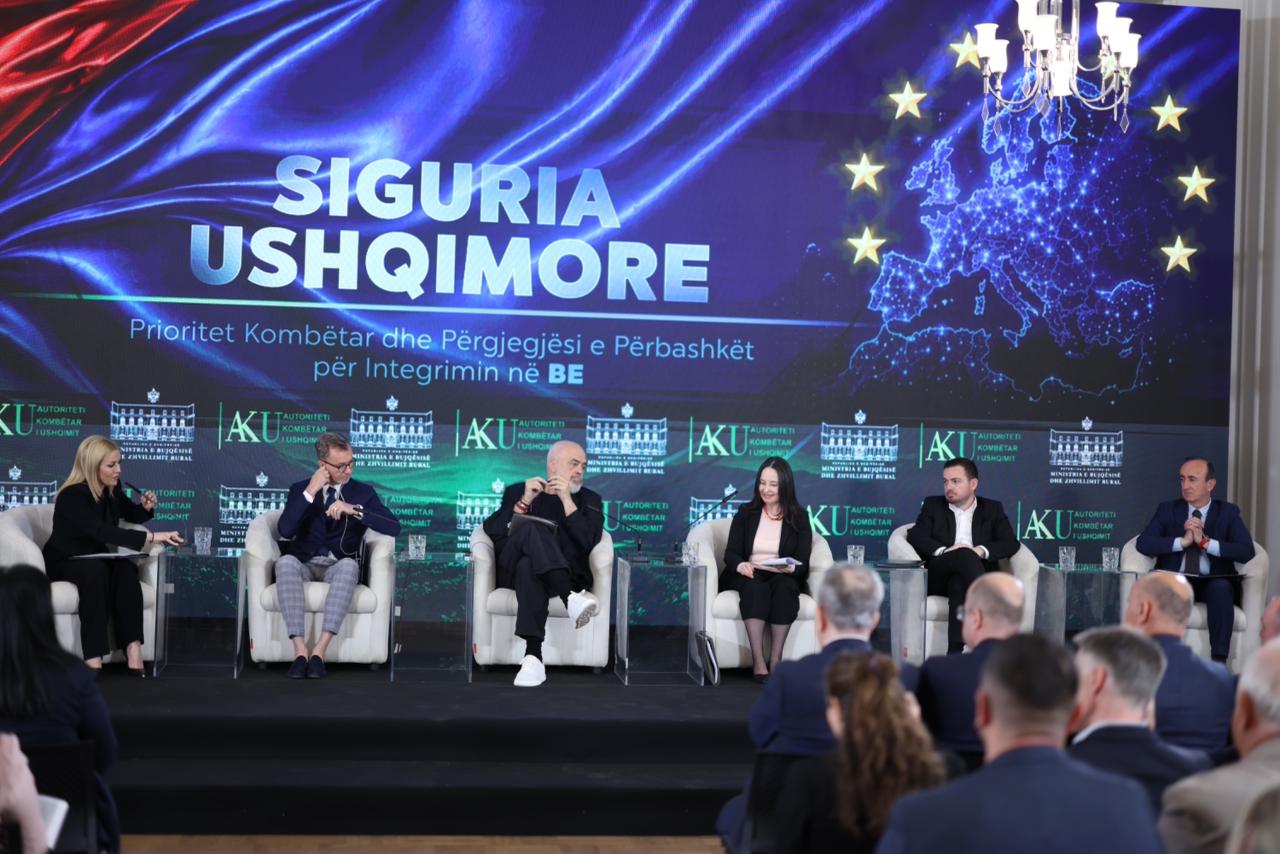


Delphi Economic Forum, Prime Minister Rama in conversation with Alexis Papahelas, Editor-in-Chief of Kathimerini
As part of his participation in the 11th Meeting of the Delphi Economic Forum in Greece, Prime Minister Rama held a conversation with Alexis Papahelas, Editor-in-Chief of the newspaper Kathimerini:
***
Alexis Papahelas, Editor-in-Chief of Kathimerini: Good evening, everyone! Prime Minister, it’s a pleasure to have you here.
Prime Minister Edi Rama: Kalispera!
– Ah, that’s the third Greek word, apart from efkaristo and sagapo poli. What was the other one?
Prime Minister Edi Rama: Kalispera and kalimera.
-Oh, we’re really getting somewhere, right?
I was thinking this morning when I saw you with the Greek Prime Minister, how many Greek Prime Ministers have you met during your tenure?
Prime Minister Edi Rama: How many? I think I also met Prime Minister Simitis, but I was not in this job. I was Minister of Culture. And then I met Prime Minister Karamanlis when I was mayor. And then I met Prime Minister Papandreou and Prime Minister Samaras. I met all of them
So you have a collection, yes. How many Turkish presidents?
Prime Minister Edi Rama: How many Turkish presidents? One and only.
-Let me ask you, we’re going through a period of geopolitical disruption, let’s say. How does a country like Albania deal with all this?
Prime Minister Edi Rama: Well, listen, when you are as small as Albania, you have, on one hand, to suffer what you must suffer, But also, on the other hand, you are somehow relaxed because you can’t change anything for good or for bad. So whatever it comes, it comes. And yes, we are a member of NATO. But still, you know, it’s not that we decide much there. And when NATO does something good, like, for example, liberating Kosovo, we say we did a great thing.
When NATO does something bad, like leaving Afghanistan, as they did, we say it’s their fault. So, because the big ones take the blame, the small ones can also take some merit when there is something to take.
-But do you have a feeling that the Balkans are kind of a forgotten neighbourhood in this landscape?
Prime Minister Edi Rama: No, I don’t have the feeling that the Balkans are forgotten. I have the feeling that we are in our best times. I mean, the Western Balkans, to be very clear. We are in our best times. We have never been closer to the European Union. The European Union has never been more aware of its importance in the big geopolitical design. We have much more visibility in many ways. In the last decade, it has become normal, but it was not at all normal to talk and cooperate. I just want to remind you that we sat around the table, all six leaders of the Western Balkans, for the first time in history, only in 2014, in Berlin.
So, no, we are not forgotten. We are in the best time we have ever lived.
-But I remember last February you were pleading with President Trump to get more involved with resolving some of the conflict
Prime Minister Edi Rama: Say that again?
–That you were pleading with President Trump. I remember last February you made the speech and said that, you know, he has to get involved in dealing with some of the conflicts which are still going around.
Prime Minister Edi Rama: Yeah, I was. I had the privilege to be with President Trump on the founding day of the Board of Peace. I mentioned something that is very much in my heart, which has to do with international justice.
Namely, the International Court of Justice was created based on a report of Fantasys, which was sponsored by the Russians, by the Vladimir Putin delegation in the Council of Europe that supported the motion for investigating the so-called crimes of the Kosovo Liberation Army and specifically the human organ trafficking.
And the court was set up to kind of turn this report of fantasies into a process against the leaders. And they took from office a sitting elected president, and they brought him to the Hague by putting him in jail before indictment and the head of the parliament. And then the whole process turned into something totally different.
So no human organ trafficking has happened. And they are practically accused of having led a rebellion against an occupier and of having collaborated with NATO. This is practically the substance. So I told President Trump that this is something that he needs to know and maybe hopefully to intervene.
-Has there been any response?
Prime Minister Edi Rama: He didn’t inform me yet, but he has been too busy, I guess.
-I want to talk a bit about the European aspirations of Albania. And Albania is a bit of a paradox to me, because on the one hand, you have a significant rate of growth. But at the same time, about what, half a million people have left Albania during your tenure? How do you explain this paradox?
Prime Minister Edi Rama: First of all, the half a million is not an accurate figure, but yes, Albanians have continued to live, and I think it’s the most normal thing for a country that has gone through 50 years of full isolation, and for people that have always been keen to emigrate and to look for a better life.
But, on the other hand, I think that there is clear evidence that Albanians are also coming back. So we are still in a net negative between people who leave and people who come back. But the gap is narrowing. While yes, we have to continue and to do a lot, but just to give you a figure, when I took office, our GDP was less than 10 billion euros, and nowadays it’s 27 billion.
So we have made quite an improvement. We counted about 2 million tourists, and last year we went up to 12 million tourists. And we had 300, 400 million euros of foreign direct investment and last year we exceeded 1.6 billion. So these are numbers that are important for a country like ours, but of course, no doubt, there is more to do for the people.
-Now, also, you know, every report I read in terms of European aspirations and so on, there is criticism about the informal economy still being like one third of the GDP, and rule of law issues.
Are you dealing with those?
Prime Minister Edi Rama: Of course, we are dealing with the reason why we have every year. I just saw the figures for the first trimester, and we are around 300 million euros more in revenues than last year, and kind of 100 million euros above the plan. And this is not all the growth, it’s also tightening the space of the informal economy.
Because we have also introduced artificial intelligence, digital tracking and so on. So it’s a fight. And when it comes to the rule of law, of course, we have issues. And of course, we are doing everything to improve in that direction. Because a journalist from Politico was asking me about, ” Are you going to finish your job with the rule of law within 2027, I said, ” If you aim to be a member of the European Union, you have to understand that you never finish with the rule of law.
It’s an eternal mantra. So we are improving, but to finish, there is no such thing as finish.
-There’s also some criticism, as you know, about organised crime being a factor in Albania. Is that a difficult fight?
Prime Minister Edi Rama: Yeah, I know. It’s criticism and, in my view, out of proportion. Because it’s difficult to accept this criticism when it gets out of proportion, especially in certain media outlets abroad.
And when you see our port and when you see Barcelona or Antwerp or Rotterdam, you know, the size and what moves in these ports is overwhelming. But this doesn’t mean that we don’t have an issue, and we have fought it very hard, and we have achieved a lot of success because finally we have succeeded in something that, for us, is a lifetime achievement.
Giving the judiciary its independence and having an independent judiciary that has engaged very much against organised crime has made a difference.
-I want to talk about some of the bilateral issues now.
Prime Minister Edi Rama:Do we have bilateral issues?
I don’t think so. We had an issue some weeks ago when everyone here got crazy because I said you are not Plato’s nephews, but it was just a way to warm up a debate with a colleague of yours. It was not a way to diminish all the values and all the beauty of the Greek culture and Greek history. So, issues like that I don’t think are very serious.
-Well, you know, I mean, actually, I want to talk to you about this because that was an interview we were doing with my friend John Defterios.
Prime Minister Edi Rama: Yeah, he’s a great guy, by the way, and I didn’t mean to make him feel like I was taking Plato from him and making him Albanian.
It was simply just to tease a bit because in this part of the world, we take ourselves very seriously, you know? And the only problem I have with Greeks and Albanians, by the way, more with Albanians than Greeks, is that taking ourselves very seriously and thinking about ourselves like we, you know.
-The other side of this is that we have to be very sensitive about each other’s history and respect each other’s culture and history. And when I watched that debate, that discussion, I was surprised because I know you and I know how easygoing you are. And all of a sudden, it was almost as if you got worked up and some hostility came out of you.
Prime Minister Edi Rama: Hostility?
God forbid, no. No, never. Listen, I, from whoever knows me, I have great admiration for this country. And by the way, I don’t know, it was Thomas Miller who said, it takes maybe a life to discover Greece, but it takes a day to fall in love.
And I have spent not one day, I’ve spent more than one day, and I always, every time I come here, I feel that I am in love with this country.
So how can I be hostile?
-Okay, maybe it was a bad moment then.
Prime Minister Edi Rama: No, it was not a bad moment. It was just me making some humour with very serious people. So maybe I was not in the right place.
-All right. I want to talk a bit about property settlements. About? Property settlements. And one of the criticisms is that you’ve dealt with this on the national level. You have like 60%… rate of success, I guess, dealing with this. But then, when it comes to the local areas where Greeks are very, you know, they have roots there, and they live there, the rates are much lower. How do you explain that?
Prime Minister Edi Rama: Listen, it’s a very, very simple and also complicated subject.
You have to understand or to remember that we were a country that was fully deprived of private property. So we went through half a century with no private property.
We were not allowed to have any square meter of land in our own ownership, nor even a private car. So after 50 years, we finally changed that horrible regime and of course, property was the main issue. And at that time, a law was passed, consensually, by both opposition and the party that came from the past, to give a paper of use to all people who were in the agricultural sector. A paper of use, not the title of property. And in the meantime, to see and deal with the old owners. And at that moment, an overlap was immediately created.
And during the years, people with this paper on the use of land became owners, old owners became owners, and a third layer was put on top of it, with many people coming from rural areas and, in the vacuum, building illegally wherever they could in agricultural lands. And then, of course, it was no other way but to legalise.
So a third layer came. And we have been dealing with all this for 10 years now, cleaning up as much as we can, digitalising, and so on.
But to cut it short, no one can prove the contrary of what I say, that the problem of property, even in the areas where Greek ethnic citizens ethnic Greek citizens is not at all different from the problems of the Albanian ethnic citizens in the same areas or elsewhere.
So, this is simply an Albanian problem for both Albanian and Greek citizens, which we are addressing, and because we have a very important level of understanding and of respect for the Greek minority, the understanding in the sense that it is a cultural treasure, and respect in the sense that they are citizens of our country.
So we have paid special attention to them, and I want to also praise Prime Minister Mitsotakis, who has been obsessive, I would say, about this. And I have considered this as a good thing.
So respect him because he fights for his people. But at the same time, I’ve told my people that, listen, we have to respect that, and we have to do more because it’s sensible, and we need to tell and to show our neighbours how much we value this neighbourhood, this relationship.
-So, would you give us data about how many of the Greek petitions in terms of property settlements have been satisfied in comparison to the national level?
Prime Minister Edi Rama: Listen, you lead a very big newspaper, and you send journalists to us, and they can come, and they can get all the information, and it would be very, very valuable also for the Greek audience if you make an accurate report based on facts that we’ll provide to you. And I’m sure that this will help.
-Let me go to Beleri now.
Prime Minister Edi Rama: To whom?
-Fred Beleri.
Prime Minister Edi Rama: Why do we have to go back there? He’s happy. He’s a European parliamentarian.
For him, it ended in a way that every other mayor in Albania who has been put in jail pre-trial would dream of. But they are still in jail.
- I don’t find it that funny because, you know, for somebody to go to jail.
I’m serious because today, not being allowed to be elected mayor is a big issue. No, no. Today, I have proof of something that at that time looked like a one-off. And I’ve tried to explain to my dear friend Kyriakos and the Greek side, which of course was very sensitive about that, and I fully respect that this is something that has to do with a pattern in our country after the justice reform, where pretrial detention is becoming a problem. And I can share it with you.
I’m not proud of that, but this is an independent judiciary now, and we have to deal with it patiently.
In Albania, we have today 58% of the people in jail that are not yet been tried.
And the mayor of Tirana, from my own party, no relation with Greece, no, he has a relation with Greece, he was a very good friend with the former mayor of Athens.
He entered jail in January of 2025, and he is still in jail today. And the trial has just started. So, when I said that, for Beleri ended magnificently because he is a Euro-parliamentarian, I mean it’s over. I don’t want to go back to that. And I have proved now that this is not just something that had touched an ethnic Greek, but it’s something that touches a lot of people, and I can count other mayors that have gone through it.
-Okay, let me just ask you to make sure that I understand. In the interview with Kathimerini, you said that this was an unfortunate episode. -What did you mean?
Prime Minister Edi Rama: It’s an unfortunate episode for him and for everyone who has to go pre-trial and stay in jail. This is not something that I take lightly. This is something I’m trying to share with our European friends. But I’ve been told this is about justice, so I just don’t comment. But this is unfortunate.
Of course, it’s unfortunate.
-Now, there’s a discussion, as you know, between the two countries about exclusive economic zones. There was an agreement, you were against it when you were in opposition, and then in 2020, you said that you’d be willing to negotiate with Greece and take this to the National Court of Justice. Is anything happening on that front?
Prime Minister Edi Rama: No, the truth is more nuanced. It was not that I was against it. It was that after the agreement was published, a famous guy in the army came out with a full paper, plenty of criticism, and this kind of inflamed the environment. Because it’s not just here. There is immediate flame when something has to do with the other side, but it’s also there. And at that time, we were in opposition. And I said, listen, this might look like a great gift that we can take, we can go to parliament, we can go to rallies, and we can scream betrayal, but this is not what we need to do, and this is not what we will do because we are not this type of party.
But at the same time, we can’t stay doing nothing, so we will bring it to the Constitutional Court. And it’s for the Constitutional Court to decide. So we took it out from the football pitch, let’s say, between parties and between fans. And this is how it went.
Now we have an agreement with the Greek government to go to the international court. So this is how it will be, and then it’s for the court to decide.
-But do you expect an announcement, an agreement, soon on this front?
Prime Minister Edi Rama: Listen, the Beleri issue has created some difficulties in our relationship, without a doubt. We lost some time. And this was another unintended consequence of what happened. But one thing has been characteristic in my relationship with Kyriakos, that we have always been respectful to each other and very much open to each other.
So, you know, no theatricals. And I respect him a lot for this. And we have decided some time ago that we should not let our two countries be, you know, kind of taken in this kind of fights because of something happening here, something happening there.
But we have to go once and for all to solve the outstanding issues among us. And this is what we are doing. The ambition is to end it this year. Hopefully, next fall to announce that for all issues we have a full agreement.
Minister Gerapitritis, who is here and I salute him, and I really admire his graciousness. He’s always gracious, even in the difficult moments. He has a great smile, so a great professor of law. So he is engaged with my foreign minister, and we are very confident. On our side, we see no issue.
So for us, all the issues are fine. We have no problem. We have, of course, the outstanding issue of the absurd law of war. We need it gone. And yeah, we have no problem with that. And we have something that is a big, big asset for us, the Greek people, a minority. And also something else, this is a big, big asset for you, the Albanian living citizens here, who are a lot and are now fully integrated.
So we owe it to both to have a very friendly relationship.
-So I understand you expect a restart and solving the issues.
Prime Minister Edi Rama: No, no, I don’t expect a restart. We have already restarted. I expect an end.
-By the end of the year?
Prime Minister Edi Rama: Before the end of the year, yes. We both expect an end before the end of the year, and hopefully, you know, because we never know. In this world, we never know what can happen, and among us, we never know what can happen.
But you see, I’m trying to be careful not to make jokes with you, exactly because I don’t want to disturb the peaceful environment we have created.
Is Alexander the Great Greek? Is Alexander the Great Greek?
Prime Minister Edi Rama: It’s what?
-Is Alexander the Great Greek?
No jokes, please.
-All right. Not funny. All right. I want to talk about energy routes in the area. There’s been some talk that perhaps Albania will become an entry point into Europe for natural gas. Is there a discussion, any plans for that?
Prime Minister Edi Rama: Listen, now I didn’t ask permission from the U.S. ambassador here. to disclose anything, so I can talk without the permission of Greeks, I can talk without the permission of Europeans, I can’t talk without the permission of Americans because they can be very nasty.
So I don’t know if I can talk about that. But yes, there is some conspiracy to make Albania.
You know, I love it when everyone in the region says, ” We want to be the hub. Everyone in the region said, “We want to be the hub of this, we want to be the hub of that.” And in the back of the mind is to swallow everyone else. No, we don’t want to swallow anyone.
We have a chance to have this thing, and our American friends are interested and helpful. And of course, on the other hand, we are very happy that we have engaged in a real conversation with Greece about matters of energy for some time.
-Also, one issue that has been discussed lately is the fact that you have a lot of Iranian dissidents in Albania. How come?
Prime Minister Edi Rama: Listen, we have a history now, again, history has to be invoked, but we have a history of hospitality that we want to keep, and we want to nourish. As you may know, Albania is the only country in Europe, and we are unique, to end the Second World War with more Jews than when the war. And where there is no record of a single Jew that has been consigned to the Nazis, we saved by protecting 25,000 Italian occupiers when Italy capitulated, and we protected them from the Nazis.
We took the Afghans, you know, after leaving Kabul in that way that was really, you know, how to call it?
As for the Iranians, we were asked to consider bringing them here not to use Albania as a platform for political opposition, but for humanitarian reasons, because they were in Camp “Liberty” in Iraq and were constantly under attack by killers from Tehran. So we said yes, they can come.
They have been here for several years now and we have saved their lives. I think there should be some recognition for “getting Albania into heaven” if we recount all these stories where we have saved lives. So, in a way, it is a way of thinking that somehow we might save ourselves from hell.
–One more question, because I think the Prime Minister is coming. There is a lot of speculation about European refugee camps in Albania. Is there any discussion about this?
Prime Minister Edi Rama: European migration camps? Italian ones. No, no, for us these are two different things. We have a “long love story” with Italy, so it is different. Italy asked us to consider offering them the possibility to set up these centres for migrants, and we said yes, because to Italy we always say yes. They do not ask much from us, but when they do, we say yes, because they have been very good to us and have stood by us in very difficult moments. So this is a special bonus. Of course, when the Italian Prime Minister is a woman, it becomes even more impossible.
– We have seen the photos of your love story.
Prime Minister Edi Rama: Even more impossible to say no. You understand that?
– I understand this also happened with the former Greek ambassador in Tirana?
Prime Minister Edi Rama: Yes, yes, with everyone, but especially with the Italian Prime Minister.
– Thank you very much, Prime Minister.