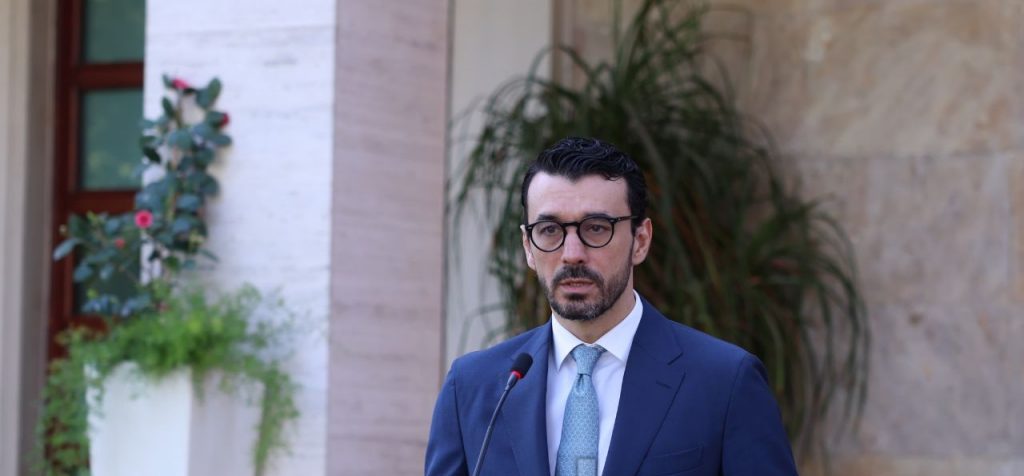


Prime Minister Rama Welcomes President of the European Council António Costa
Prime Minister Rama today welcomed President of the European Council António Costa, who visited Tirana as part of his diplomatic visits to the six Western Balkan countries, ahead of the EU–Western Balkans Summit to be held on June 5 in Tivat, Montenegro.
The summit is being held six months after the last summit in Brussels, reaffirming the strengthening of the EU’s relations with the Western Balkans. The summit will be chaired by the President of the European Council and hosted by the President of Montenegro.
Following the joint meeting between the two delegations, Prime Minister Rama and President of the European Council António Costa held a joint press conference.
***
Prime Minister Edi Rama: Good afternoon, everyone! Thank you!
Once again, I must welcome to Tirana, to Albania, for the fifth time, a friend who has always been increasingly committed and valued by Albania, but also by the Western Balkans; a tireless supporter, from the very beginning, as Prime Minister of Portugal, of the European Union enlargement process and of the union of the Western Balkans with the EU, and today, in his capacity as President of the European Council, in another cycle of meetings in the Western Balkans before the joint meeting that we will have between the EU and the Western Balkans in a few days in Tivat, Montenegro.
Welcome, dear António!
It is always a pleasure, not because of protocol nor because of unconditional hospitality, but because every meeting with the President is one hour, two hours, or three hours of learning, learning from great experience and certainly also from a deep knowledge of European affairs, world affairs, economic issues, social issues, and so on.
But today I want to thank António especially for his continuous engagement and tireless support, even before we practically achieved the closing of the first phase, or more precisely, the closing of the phase of opening the chapters, with the intergovernmental conference a few days ago, and the opening of the phase of closing the chapters, at a time when all of us together face many challenges that are not our individual challenges, but increasingly common challenges.
Likewise, we fully share with the President the conviction that the main part of our work here remains our work. This means that we have tasks to fulfill, not for the sake of Brussels, or Berlin, or Paris, but for the sake of improving the performance of the state, the institutions, and the independent powers in Albania. And certainly, now in this phase, the main emphasis is on the implementation of those reforms that have been successfully carried out, or of all these laws that will continue to enter the body of Albania’s legal organism from the Acquis Communautaire, or the EU legal body.
Naturally, this is a process with many challenges. The President has rightly suggested that we increase our efforts to acquaint the wider public with all these challenges that accompany every step we take forward.
We spoke about Portugal’s experience before and after accession, about the experience of farmers, the experience of wine producers, and the challenges they had to adapt — challenges accompanied by pain but then followed by success and much better results for their farms and their products.
What makes it difficult for me to go on at length is that we have 100% agreement on all issues. We have 100% agreement regarding the tasks we must do. We have 100% agreement regarding the necessity to move at this pace and begin closing the chapters. We have 100% agreement that we must do our utmost for the region as a whole to function as a cooperative collective, and we have 100% agreement that all of this is easier because, on this path, we are not alone, but we have an extraordinary partner, which is the EU, and an extraordinary source of knowledge, which is the negotiation process and the interaction with the European Commission.
So, I do not want to go on any further, and in fact I cannot go on, because we have no problem, no concern that divides us; we have only concerns that unite us.
I want to thank the President once again, warmly and sincerely, give him the floor, and then, naturally, answer the respective questions from the journalists present.
President of the European Council, António Costa: Thank you, very much dear Edi, for your warm welcome to Tirana and for your hospitality. It’s always a pleasure for me to come here. And today I can only welcome and applaud Albania’s determination and efforts to become a member of the European Union – thanks in no small part, dear Edi, to your personal commitment to this process.
Last week’s Accession Conference confirmed your progress, as Albania has met the interim benchmarks on the first ‘fundamentals’ cluster. It is a clear recognition by the member states of Albania’s commitment to further advance on the path towards membership of the European Union. This marks the beginning of a demanding next phase in the process, focused on implementation and a solid track record.
As you often say, these reforms, more than the European Union’s conditions, are your choice to build strong democratic institutions in Albania. Continued, tangible political commitment to the rule of law and in safeguarding an independent and accountable judiciary are essential foundations for EU membership. I encourage you to step up the efforts in fighting corruption and organized crime.
The European Union is the Western Balkans’, and Albania’s, most reliable partner, its main investor and trading partner. The European Union supports Albania’s prosperity and security through concrete projects and policies that benefit your citizens, for example:
- you have access to the Single Euro Payments Area;
- you are gradually integrating in the EU Single Market, the ‘Roam Like at Home’ and the DiscoverEU rail pass scheme.
But EU membership is about more than access to the Single Market. It means joining a political Union built on common values and shared strategic choices. The European Union has forged lasting peace and stability for its member states through resilient democratic institutions and strong economic bonds. Enlargement offers those same opportunities to our neighbours in Europe – like Albania.
But in this time of global geopolitical uncertainty and economic instability, more than an opportunity, enlargement is also a geostrategic necessity for Europe. It is an investment in the peace, stability and security of our continent.
For that reason, I am also looking forward to seeing you again very soon at the European Union-Western Balkans Summit this Friday in Tivat. The Summit will be a clear demonstration of our determination to bring forward our cooperation and build on the momentum of the European Union’s enlargement.
Dear Edi, you have a tradition of introducing me to modern Albanian literature. I have already read Lea Ypi’s books, and Ismail Kadaré’s work is on my summer reading list. I am grateful for these recommendations, as they help me better understand Albania’s perspective and serve as a reminder that we share a long and common history.
Today, we are not only reflecting on our shared history; we are also shaping a shared European future together.
Thank you.